Categories
Blog

Barnet’s air quality. Why we should be concerned.

by Peter Piper, updated 4 October 2021

[Editor’s note: we have been contacted by Mums For Lungs, and you may like to work with them if you want to campaign about air quality in London.]

From 2016 to 2019 Central London experienced significant improvements in air quality [1], As a result there was a 97 per cent reduction in the number of inner London schools exceeding legal pollution limits – from 455 in 2016, to just 14 in 2019 – as well as a 94 per cent reduction in the number of these areas exceeding legal limits for nitrogen dioxide (NO2). It is predicted that this should increase the average life expectancy of a child born in inner London in 2013 by six months [1].

Despite this, the levels of air pollution in London are still far too high and the improvements in air quality in inner London have not happened in many outer boroughs. An Imperial College study concluded that toxic air had contributed to the deaths of more than 4,000 Londoners in 2019 [1], the boroughs with the largest number of air pollution related deaths in 2019 being Bromley, Barnet, Croydon and Havering [1].

That pollution-related deaths are higher in outer boroughs is partly a reflection of the higher proportion of elderly residents in these boroughs. Older people are generally more vulnerable to the impacts of air pollution. We know that air pollution increases the severity of other health problems, like heart attacks, strokes, diabetes and high blood pressure. Other factors are also involved. Londoners exposed to the worst air pollution are more likely to live in deprived areas and to be from Black, Asian and Minority Ethnic communities. There is also evidence linking air pollution to an increased vulnerability to the most severe impacts of COVID-19 [2].

The expanded ULEZ may exacerbate the problems Barnet faces when dealing with air pollution.

The success of the existing central London Ultra Low Emission Zone (ULEZ) gives confidence that the expansion of the ULEZ on 26 October 2021 [3] and tighter standards for heavy vehicles across the entire city will deliver wider benefits. It is predicted that this will prevent more than one million hospital admissions over the next 30 years, thus saving the NHS around £5 billion and [1,3]. Barnet Council has produced detailed information as to the parts of the borough most affected by air pollution, as part of its plan detailing actions it aims to deliver between 2017 and 2022 in order to improve local air quality in the borough [4].

The boundary of the new, expanded ULEZ will be at (but not including) the A406 North Circular [3]. Unfortunately as much of Barnet lies outside of this new ULEZ, this ULEZ expansion is unlikely to lead to a substantial improvement of air quality in the borough. Instead it may lead to many residential streets near the A406 in Barnet becoming more congested and polluted, as drivers try to avoid the charge. There are also the highly polluted trunk roads north of the A406 such as A1, M1, A41, A5 and A1000 that are not in the new ULEZ and will not therefore see much reduction in vehicle pollution.

BCAG would like to see a prioritisation of Barnet Council’s stated objective of exploring the option of increasing the ULEZ to cover the whole of Barnet. This could potentially have the most significant impact on improving air quality in the borough. GLA evidence for ULEZ expansion predicts a 31% reduction in NOx emissions in Barnet by 2025 if all of Barnet were to be in a ULEZ, but only an 8% decrease with just the area south of the A406 is in the new, expanded ULEZ [3].  Year-on-year diffusion tube measurements NO2 at 15 sites across Barnet show a moderate 7 year decline [4] (the more dramatic decline 2019-2020 probably being due in large part to the Covid lockdown, strong winds or high rainfall over this period). It will be interesting to see whether the diffusion tube measurements of NO2 at the 15 sites currently being monitored in Barnet [4] change significantly with the expansion of the ULEZ.

Furthermore, while expanding the ULEZ will help reduce NO2 levels in inner London (the latter mainly due to diesel exhaust), we will still be faced with the problem of breathing in unacceptable levels of PM2.5 particulates (ninety-nine per cent of London does not meet WHO recommended limits for PM2.5 – the particles most dangerous for health). Expanding low traffic neighbourhoods might not always solve this PM2.5 problem, since they can lead to traffic being diverted from more affluent “leafy” roads to busier, potentially less affluent areas. An Imperial College study of pollution levels in the Marylebone Road during lockdown found that particulate pollution from tyres and brakes did not decline with the reduced volume of traffic, since this traffic was now moving faster.

The prospect for real-time monitoring of the pollution in Barnet.

Barnet Council has produced a detailed pollution map of the borough [4]. However pollution levels at all of these sites will vary considerably over time with changes in traffic levels, weather conditions etc. What is needed is up-to-date information provided by continuous monitoring of pollution throughout the day (“real-time” monitoring). For the past few years Barnet has been continuously monitoring NO2 and PM particulates at two sites (Tally Ho and Chalgrove School)[4], the data being available on the Air Quality England Website : (https://www.airqualityengland.co.uk/local-authority/?la_id=185)

BCAG would like to see Barnet increase the information available to the public through “real-time” monitoring of pollution by: (i) becoming included the London Air Quality Network [5] and (ii) expanding its participation in the Breathe London real time monitoring of pollution [6].  Breathe London is currently placing sensors for continuous monitoring of PM2,5 pm10, temperature, humidity and pressure (not NO2)) at 300 sites across London [6] (see https://www.youtube.com/watch?v=R8_vm1sXkLk ). Although not stated in Barnet’s latest Updated Air Quality status report [4], 4 of these air quality monitors (called Node-S) were recently installed in Barnet (at Wessex Gardens Primary School, Orion Primary School, Martin Primary School and Cat Hill allotments). This welcome inclusion of Barnet in Breathe London will allow its residents, especially those with respiratory problems and those with children, to use the CityAir.app to know when best to negotiate Barnet’s pollution hotspots (the sensors continuously monitor PM2,5 pm10, temperature, humidity and pressure [6]. Furthermore, in addition to these Breathe London sensors, boroughs and other organisations will be able to ‘buy in’ extra sensors to the network at a greatly reduced cost [6]. Since the sensors cost only £40-50 each it is hard to see how failure to introduce a network of them can be defended simply on the basis of its cost. Instead, such a network of sensors could supply online localized air pollution data in real-time for multiple sites in Barnet where residents are potentially exposed to pollution. Residents will then be able to use the CityAir app to minimise pollutant harm to themselves and to their children, Policymakers can also identify problem areas and take steps to protect those who are most at risk, including school children and the residents of lower-income neighbourhoods. The technology is now available. BCAG believes it should be introduced more widely as a matter of priority.

Improving air quality is vital for our children’s future.

Children are one of the worst affected groups when it comes to air pollution [8-10]. According to Unicef UK, children are growing up breathing hazardous levels of toxic air across 86% the UK. It stunts their lung development and increases risk of asthma and pneumonia. Furthermore children breathing toxic air are four times more likely to have reduced lung function in adulthood. All policymakers should take necessary action to protect children especially from road transport emissions. A recent study found that children are most exposed travelling to school, not in the classroom [9]. Note how dramatically the sudden surges of NO2 in the environment of Barnet’s Chalgrove School disappear during the school summer holiday period :-
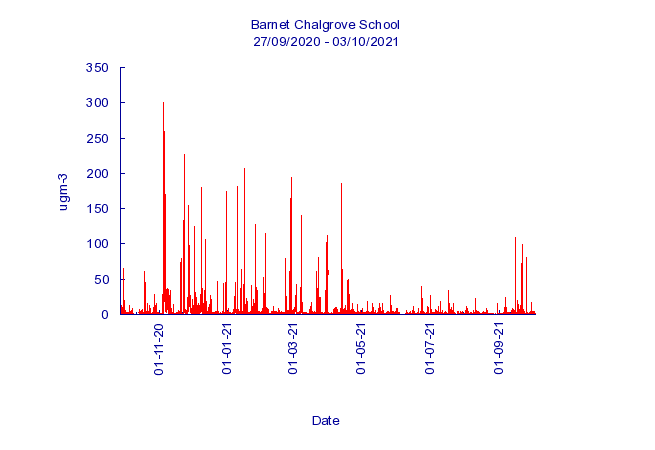
graph showing nitrogen dioxide levels from October 2020 to September 2021

BCAG would also like to see the right air quality standards – legally binding WHO recommended limits on pollutants – to be achieved by 2030, adopted in the Government’s new, but at present underwhelming, Environment Bill. This will be a once-in-a-generation opportunity to rebuild our cities and economies to be greener, fairer, and more sustainable. However under the Government’s current plans, air pollution in the UK is expected to remain at dangerous levels for at least another 10 years [7]. The estimated cost to health and social care services is upwards of a staggering £2 billion [8], as a result of its impact on heart disease, stroke, lung cancer and childhood asthma. The sources of pollution around London schools have been subjected to detailed analysis [10].

Websources:

[1] https://www.imperial.ac.uk/news/213273/tackling-londons-pollution-will-increase-life/

[2] https://www.sciencedirect.com/science/article/pii/S0269749120365489

[3] https://tfl.gov.uk/modes/driving/ultra-low-emission-zone/ulez-expansion

[4] https://barnet.moderngov.co.uk/ieListDocuments.aspx?CId=695&MId=10912&Ver=4

[5] https://www.londonair.org.uk/london/asp/lahome.asp

[6] https://www.breathelondon.org/

[7] Department for Environment, Food and Rural Affairs: Clean Air Strategy

[8] Public Health England: Estimation of costs to the NHS and social care due to the health impacts of air pollution, https://www.gov.uk/government/publications/air-pollution-a-tool-to-estimate-healthcare-costs

[9] https://www.london.gov.uk/press-releases/mayoral/walking-to-school-on-back-streets-halves-pollution

[10] https://www.edfeurope.org/news/2020/10/11/new-data-air-pollution-sources-london-schools

[11] https://www.unicef.org.uk/press-releases/child-health-experts-warn-air-pollution-is-damaging-childrens-health/

Categories
Event Meeting Notice

May 2021 Meeting — Barnet Climate Plan Workshop

Update 24 May: reports and slides are gradually being assembled on the Barnet Climate Plan page.

Barnet Climate Action Group will be hosting an online workshop from 2pm to 5pm on the afternoon of Sunday 16 May 2021 to discuss citizen, business and council climate action needed in the London Borough of Barnet to respond to the Climate Emergency.

The current plan is to have an introductory session all together followed by two breakout sessions and a final plenary.

In the first breakout session, we will break up into two groups to discuss in parallel:

  • Buildings
    • Retrofitting existing buildings
    • Domestic and non-domestic buildings
    • Energy efficiency
    • Renewable heat and renewable power
  • Waste and Consumption
    • Waste reduction, food waste and recycling
    • Plastics
    • Circular economy
    • Spending in a climate friendly way
    • Food: meat, dairy, plant-based, vegan, vegetarian

You may join whichever group you wish.

In the second session we will discuss, again in parallel:

  • Transport
    • Reducing car use and switching to electric vehicles
    • Public transport
    • Walking and cycling
    • Deliveries
  • Nature
    • Green spaces
    • Trees
    • Rewilding
    • Biodiversity
    • Flood prevention using nature

If there is something not mentioned that we ought to cover, let us know and we will add it to one of these lists. When it is not obvious, topics will be assigned to these in an arbitrary way. For example industrial emissions will be discussed under Buildings, as a lot of industry in the borough consists of offices.

We have allocated quite a long time so everyone gets a chance to have their say. If you can’t spare that much time, feel free to attend just part of the workshop.

We are hoping to assemble some suggested background reading here. As a start:

Please book via the Eventbrite page at https://www.eventbrite.com/e/a-climate-plan-for-barnet-tickets-152394424827 . The Zoom link will be sent to those people who have registered. There are also more details of the timetable on that page.

Categories
Uncategorized

April 2021 Meeting — Planning for a Barnet Climate Plan

Ahead of Barnet Climate Action Group’s forthcoming workshop (Sunday 16 May), this month’s BCAG meeting will be a planning event for the workshop, asking attendees for their thoughts on the key issues for the borough that need to be examined to input into a future Barnet Climate Plan.

We would really value your thoughts on how we can get the best out of our May workshop – so look forward to seeing you on Thursday 22 April 2021 at 6.30pm.

The Zoom link for the 22nd April meeting has been sent round to the mailing list. If you are new and would like to join the mailing list, please send an email to the webmaster at the address at the end of the page — sorry it’s an image to reduce spam.

Categories
Event Meeting

March 2021 Meeting — Net Zero Finchley: A Thought Experiment

Thursday, March 18, 2021
6:30 PM – 7:30 PM online

Please register on Eventbrite at https://www.eventbrite.com/e/net-zero-finchley-a-thought-experiment-tickets-146320497547.

It is estimated 80% of buildings in our cities today will still be here in 2050. How could one part of LB Barnet – Finchley – go Net Zero?

The Government has set a Net Zero CO2 emissions target for 2050. Retrofitting UK’s 27 million homes and millions of non-domestic buildings remains one of the biggest challenges to achieve Net Zero. It is estimated that 80% of the buildings in our cities today that still be here in 2050, therefore efforts to reduce emissions must primarily focus on existing stock. But how can this such wide scale retrofit be undertaken? How much of an inconvenience will it prove to be to households? What technologies do we need to deploy to decarbonise? What buildings should be tackled first? What are the cost implications?

Taking one part of Barnet as a ‘thought experiment’ – around the main high streets of Finchley – what would be required to retrofit buildings in this area such that they would be fit for a Net Zero future? Please come along and contribute your thoughts!

This event will be held online: please register on Eventbrite using the link above.

Categories
Event Meeting Notice

January 2021 Meeting — 2021: Climate Talks – Local Actions

Tuesday, January 12, 2021
6:00 PM – 7:30 PM online

Please register on Eventbrite at https://www.eventbrite.com/e/2021-climate-talks-local-actions-tickets-133987631613.

Despite the pandemic, climate and energy headlines dominate the news. We look at the pathway to COP26 and the role of local actors.

In November 2021 the UK will host the international climate negotiations for the first time. The UNFCCC Conference of Parties (COP) 26 will be held in Glasgow from November 1-12. Details of the event are set out on the official conference webpage at ukCOP26.org

Leading up to the COP, the Government will be making some significant decisions on the future of energy policy in the UK. Recent weeks have seen the publication of the Energy White Paper and the Committee on Climate Change’s advice to Government on the Sixth Carbon Budget (which covers the years 2033 – 2037). The coming year will see a number of new strategies published which will impact on the way we live our lives. From heating our homes (Heat and Buildings Strategy), to the way we travel (a Transport Decarbonisation Plan), to our green spaces (a Trees Strategy) and even what we eat (a National Food Strategy).

BCAG’s January 2021 meeting will highlight some of the key discussions and decisions leading to the COP event, and importantly, how new policy outputs from Government will work their way into local decision-making – into our homes and neighbourhoods – and what opportunities we have to influence these decisions.

We are delighted to have as a guest speaker for this event Kirsty Hamilton. Kirsty has three decades of international experience in tackling and leading efforts on climate change and accelerating the energy transition and has been an Observer in the UNFCCC process since the early 1990s. She is currently seconded in to advise the COP26 Energy Transition team on private investment and ‘investment confidence’ for governments.

Since returning to the UK in early 2000s she has focused on bridging between leading energy finance practitioners and senior policy counterparts on clean energy outcomes originally setting up an initiative through an affiliation with Chatham House in 2004. She went on to establish the Low Carbon Finance Group (2010-2015), founded by senior financiers, heading its factual policy engagement throughout the electricity market reform process. Advisory work has included Specialist Advisor to a UK Parliamentary Inquiry into Financing Energy Infrastructure and a senior policy advisor to a leading energy storage investor. Kirsty’s ‘Finance Guide for Policymakers’ BNEF, Chatham House, UNEP-FS can be downloaded here.

Zoom link: to be provided via registration.

This event will be held online: please register on Eventbrite using the link above.

Categories
Event Meeting Notice

November 2020 Meeting — Electric Vehicles in London’s suburbs

Thursday, November 19, 2020
6:00 PM – 7:00 PM online

Please register on Eventbrite at https://www.eventbrite.com/e/evs-and-outer-london-decarbonising-transport-in-the-suburbs-tickets-128651687661.

How can we successful implement Electric Vehicle (EV) strategies in London’s suburbs?

Part of London Climate Action Week https://www.londonclimateactionweek.org/

14- 20 November 2020 #LCAW2020 #EVsOuterLondon

As London boroughs begin to implement actions to accelerate the take up of electric vehicles in their climate emergency plans – join us to explore what key issues challenges and opportunities will London’s outer boroughs face

London is seeing a slow but steady shift to the electrification of transport. The past year has seen more than 1,000 new charge points installed at petrol stations, in town centres and retrofitted into street lighting columns. More than 2,000 electric black cabs are now on London’s streets and Transport for London runs Europe’s largest electric bus fleet.

While mode shift is key to cleaning London’s air, reducing congestion, vehicle related injuries and greenhouse gas emissions, there will ultimately still be some essential vehicles on the road. These vehicles need to be zero emission. Electric vehicles in particular, will play a key role in London’s green recovery post-pandemic. They produce zero tailpipe emissions, are quiet and has and can create new jobs in battery manufacturing across the UK.

London is some way ahead of the rest of the country when it comes to charging infrastructure, with 28.8 charging points per 100 electric cars (compared to the national average of 12.5). Wandsworth is the London borough with the highest availability of chargers, with 34 per 100 electric vehicles however Outer London boroughs have the fewest charging points, with Harrow having the least with just 14. This works out as 1.7 per 100 electric vehicles. However, more of Outer London’s households have off-street parking, and home charging should be a more viable option. Also only 40 per cent of inner London households having access to a car, compared to 70 per cent in Outer London.

On average, car owners drive slightly more than six kilometres on a typical day, but those living in Outer London travel, on average, nearly 2km further per day (close to 7km) than those from inner London (5km per day).

More information on TfL and EVs

London EV Infrastructure Delivery Plan (PDF)

DfT Decarbonising transport: setting the challenge

This event will be held online: please register on Eventbrite using the link above.

Categories
Event Meeting Notice

October 2020 Meeting — Barnet’s Waste Policies

A presentation and discussion around London Borough of Barnet’s existing and future waste policies

Thursday, October 15, 2020 6:30 PM – 8:00 PM online

October’s BCAG meeting will explore opportunities to reduce the environmental and climate impacts of waste streams in the London Borough of Barnet, including waste avoidance and minimisation, re-use, recycling, composting and the use of waste streams to generate energy.

**A full agenda will be available shortly. Following registration a zoom link will be forwarded nearer the time of the event.**

Please register on Eventbrite at https://www.eventbrite.com/e/barnet-climate-action-group-barnets-future-waste-tickets-123674023333.

A list of policies and information notes from Barnet Council on their waste programmes follows below.

We hope to see you on the night!

Barnet is one of seven London local authorities making up the North London Waste Authority (NLWA).

Barnet council’s waste policies are set out in this 2018 information note: Barnet Council Household recycling and waste policies

Further information is provided in the Barnet Reduction and Recycling Plan (September 2019)

The council’s key programmes and progress against them is set out in Barnet’s Environment Delivery Plan (published in March 2020) – the previous year’s report can be seen here.

Charging for garden waste collections (a report in this policy can be seen in the following Environment Committee paper from January 2020)

Barnet webpages also exist for the following:

Barnet Council suspended brown bin food waste services in November 2018

A note on reducing food waste

Waste collection in flats

Categories
Blog

Reducing carbon emissions from Barnet’s homes

by Syed Ahmed

A great blog by housing energy efficiency specialists Parity Projects on the workforce required to see homes on a zero carbon pathway – and the retrofit tasks and skills required to upgrade homes. As a reminder of the challenge just in Barnet – never mind the UK – there are 160,000 homes in the borough. The latest data shows that through the Mayor’s energy efficiency scheme have supported the retrofit of exactly 200 homes in the borough since 2016 (see data here). The Energy Company Obligation (ECO) programme is the Government’s main household energy efficiency programme. The latest data published by the Department of Business Energy and Industry (BEIS) shows that just over 5,000 homes received an energy efficiency improvement since this new phase of the scheme began operation in 2015. (See BEIS statistics for March 2020 here – tab 4.4 of the spreadsheet there).

So – over the past five years or so, being generous, some 5,500 homes in Barnet have had some form of energy efficiency improvements installed through a targeted programme. In addition – approximately 1.6m boilers are replaced every year across the UK. Barnet’s likely share of this would be about 10,000 or so per year – 50,000 over the past five years – which would all have improved the energy efficiency of homes.

Whilst this level of activity is to be welcomed, none of the work currently being undertaken in existing homes achieves anything near the zero carbon standard needed to fully address the climate emergency. Much deeper retrofits are required, and the scale of action needs to be significantly increased if we are to reduce emissions from the domestic sector across Barnet and all other parts of the UK.

Prioritising energy efficiency in Barnet’s homes will boost opportunities for local building services companies, insulation firms, plumbers and other associated trades. These are exactly the SMEs currently being hammered during the lockdown. Boosting energy efficiency will be good for Barnet’s homes, for tackling fuel poverty, for resident’s health and supporting local businesses and employment.

Categories
Blog

Post -Covid 19: What Will Be The New Normal?

by Tony Sarchet

A crisis as serious as the current pandemic has put normal life on hold. At the same time, it raises certain concerns about exactly what kind of normal life we should be hoping to return to once the crisis has passed. A lower carbon one would be nice.

Here are a few questions that have occurred to me, prompted by the changes we have all been living through:

Now that we’ve all been forced to get used to conducting meetings from home using platforms such as Zoom, will companies in future enthusiastically revert to spending large sums of money sending their employees across the country, continent or world to check into expensive hotels in order to transact business? Or will some proportion of them decide to forego the jet lag, the travel time and the expenditure? What will this mean for projected future airline capacity? Will the money these airlines are already pleading the government to bail them out with turn out to be money well-spent?

And now that companies have been forced to make arrangements for many of their employees to work from home, how many of them may occasionally prefer not to have to undergo the crowded and stressful daily commute? Will this have an impact on future passenger numbers?

And now that many smaller companies which previously supplied produce exclusively to restaurants and cafes have started offering home deliveries of fresh fruit and vegetables of impressively good quality, how much of a chunk of the big supermarkets’ consumer business might they retain? And wouldn’t this be good for both growers and wholesalers, and maybe even help to reduce food miles?

The new normal seems to be a place where there is such a thing as society, where people in medicine and the caring professions are regarded as heroes. I wonder what else will be discovered – or rediscovered?

Categories
Event Meeting Report

Report on meeting with Alex Gilbert

12th February 2020, 6.30pm, St Mary’s Church, Hendon Lane N3 1TR

NOTES
Present: 27

Welcome By Philip Davison and reading of poem – “The meaning of existence” by Les Murray.

Syed Ahmed gave an update on Barnet Climate Action Group (BCAG)
We agreed to link ourselves to the Friends of the Earth Climate Groups which will give us access to information and resources
Charles Wicksteed had offered to build a BCAG website. This now exists in skeleton form. It can be found at barnetclimate.org.uk. Claire Martin is happy to run @barnetclimate twitter. [Update: this page used to say “Actually @B_C_A_G”, the old name, but now it is indeed @BarnetClimate (Ed)]
Syed Ahmed, Jeffrey Newman and Philip Davison met with the Barnet Director of Environment, Geoff Mee, Adam Driscoll and Robert at the council offices in Colindale. There is a desire to actively promote dialogue. The climate message needs better coordination. There is an issue of politics in this borough (!). It was acknowledged that information for businesses and residents was hard to find on the website. GM and Barnet Environment are taking these matters seriously.
Letter to Theresa Villiers – a work in progress with Green Christians Barnet.

Presentation: The Future of Transport and Energy in London, Alex Gilbert

Alex is an investor and advisor and focuses on opportunities within Clean Technology, Future Infrastructure and the Energy Transition.

Alex acts as an independent ‘Green Infrastructure’ investor and advisor, focusing on: the ‘energy transformation’; clean-tech investment; and the financing of smart, low carbon, sustainable cities.

He is currently curating, commercialising and delivering the energy projects that will assist in the transformation of TfL; London’s largest and most significant energy user.

The context – increase in powers of Local Authorities and cities with decline at national level. The direction is the rise of the city state. London has notable cohesion.
TFL – working for innovative integrated infrastructure. TFL is a transport authority but much more beside. It has power and influence to make an impact on the city greater than similar organisations in other cities eg building 10,000 homes – the most active housebuilder in London – operating 17 modes of transport. With integration it can achieve as low carbon as possible. There is need to support SMEs, local enterprises and logisitics – 500million packages come into London.
What is the future of the city? More congestion, more deliveries and returns. There is a need to join up freight fleet organisation corporate sellers, streets and modes of transport.
The way we order is important – bulk buy, local drop offs.
Target is to have 10,000 banks of lockers impacting both the environment and community.

Q – next day delivery – we are used to it but is it necessary?

Transport and energy.
Commercial development: TFL has some 6,000 acres
Waste heat capture: fuel poverty is a big issue, along with the movement to low carbon homes. Working on capturing heat from the tube both to get it out of the underground system and also use it to heat homes
Renewables wherever possible – using rooftops for solar. Feasibility of trackside solar?
Electric vehicles: charge point hubs.2040 mayor strategy is 80% journeys not by car. Demise of the car in the inner city? TFL to lead on building hubs. Infrastructure not like functional patrol stations and not piecemeal development but rather strategic placing.
Electrification is essential – buses 2030 and zero carbon rail.

Q – is proposal to increase air quality in the tube? Yes! Air quality is a big issue. Problem is cleaning stations and old trains and tunnels. We are though not in the tube for that long. Looking at sucking particulates out of the air. Ultimately new trains.
Q – local transport issue West London Orbital railway (Cricklewood to Ealing) The tracks are already there
Q – Electric Vehicle chargers in Barnet, TFL thoughts.
How do we drive down car ownership and what will replace it? TFL talks to all boroughs. There are different types of charging, slow (home), fast and rapid (50KW+). Rapid charging is closer to filling with petrol.
TFL concentrate on those who have to drive – taxis and fleets – public will be less than 1/3. Co-locate with bus hubs, elockers and ebikes. There is a danger of EV congestion as ULEZ expands. Aim is to decrease use of cars.
TFL housing developments are all car free.
Q – terrace houses parking and charging. Need to rethink future of fuel. Need to provide a service – public charging facility.. Possibility of shared taxi-type transport. With latest technology pick up on demand. Increase in charging points means increase in electricity supply – is that all renewables?. City planning – private hire taxi option with car share and ride share. In Netherlands developments have 30 flats with 4 shared cars.
Hubs with top quality facilities, possibly local solar. Offer many opportunities to charge and dynamic pricing eg solar in middle of day for free.
Pressures in grid are huge. Decarbonising electricity required – still using fossil fuels.. Essential national question – keep decarbonising the grid.
Q – e-cargo bikes: TFL has a freight strategy stepping down ultimately to cargo bikes for the last mile (the most expensive part of the system)
Q – storms and resilience plans of TFL and flood prevention. There is team focusing on climate change, adaptation & mitigation. Also house building.
Q – cool tubes? Adaption to climate change challenge also an opportunity eg waste heat.
Q – phone charging lockers at Victoria station. Revenue £100K per year yet got rid of…terror threat!
Nov 29 5.035million journeys a record.
Heat – old stock. Need for deep tube upgrade, Northern line is deepest tube in world.
Q – orbital route. Is it necessary?
Realism necessary. Possibilty of trams in outer boroughs
Local transport and get rid of short journeys across London
DLR change in communities astonishing
Opportunities new communities city energy etc